Blog9 November 2026
A Bologna Food Walking Tour of the Quadrilatero
A Bologna food walking tour of the Quadrilatero: how the old guild streets work, a route through the market lanes, what to look for and when to go.
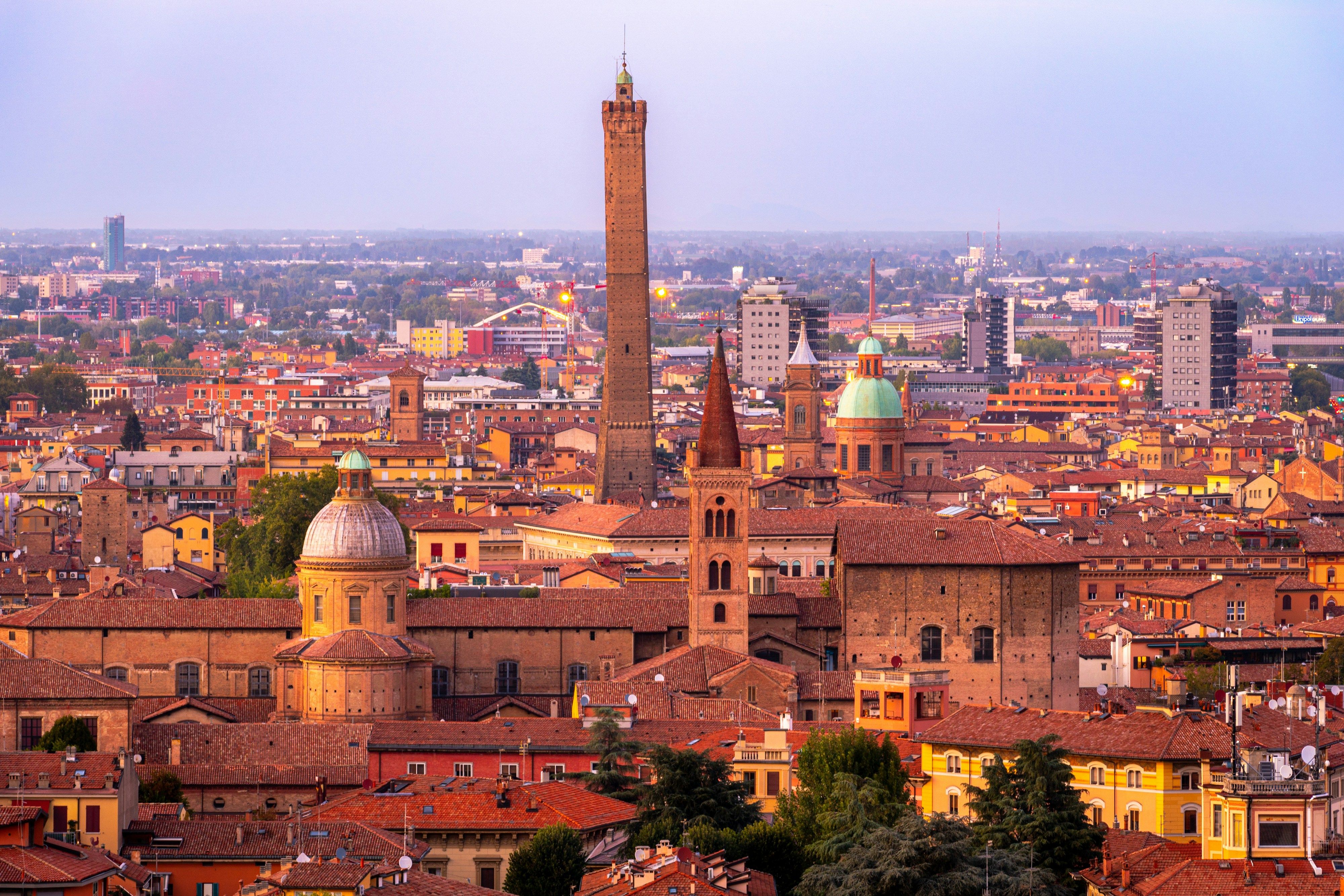
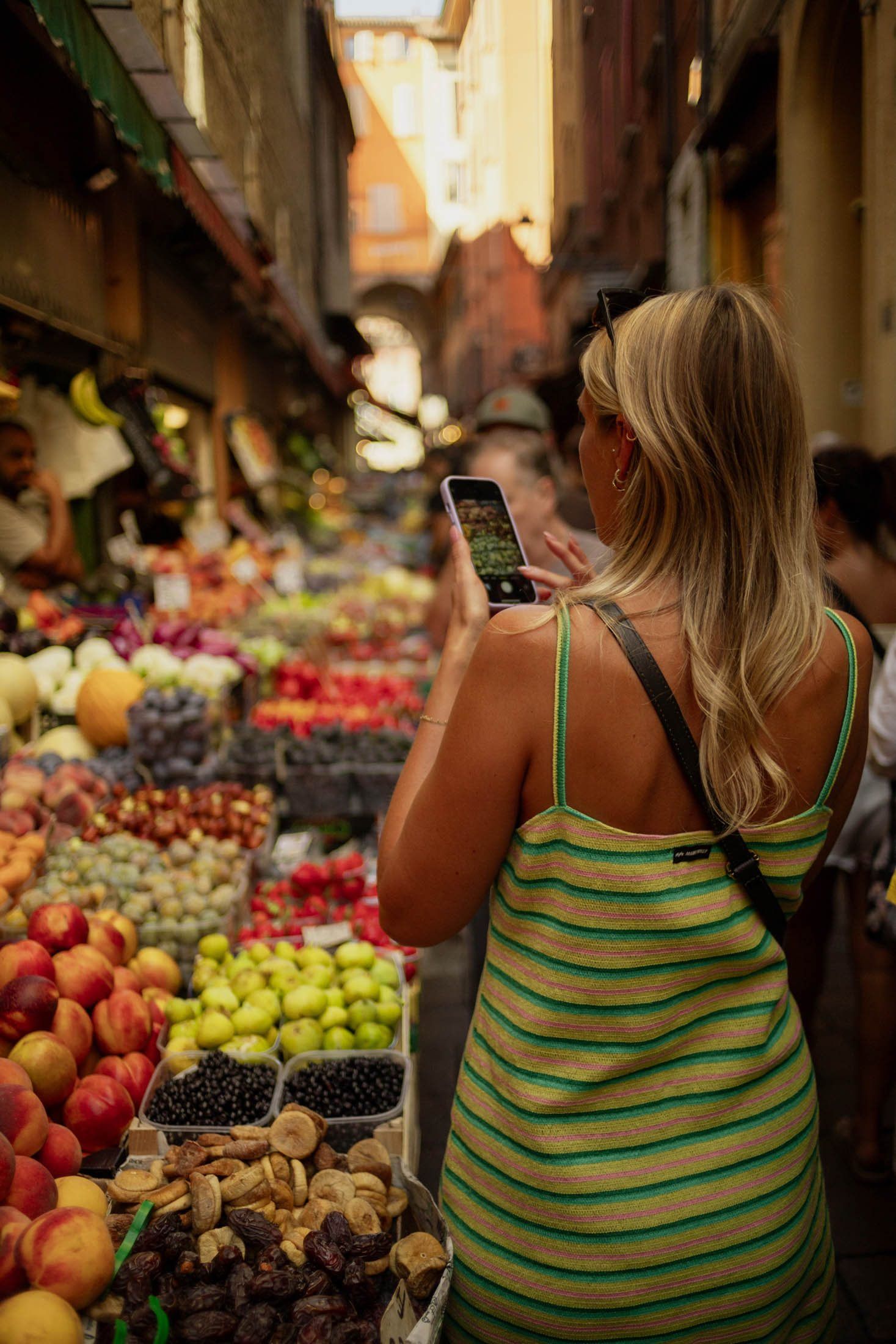
The best Bologna food walking tour covers less than half a square kilometre. Step off Piazza Maggiore through one of the archways on its eastern side and you are in the Quadrilatero, the knot of narrow lanes that runs towards the Two Towers. It has been the city’s market since the Middle Ages, and it still is: fruit spilling out of doorways, mortadella sliced to order, fresh pasta laid out in trays, and wine glasses on barrels by early evening.
Most visitors walk through it in ten minutes on the way to somewhere else. That is a shame, because the Quadrilatero rewards slowness. This guide is about how to walk it properly, on your own or with a guide: how the old guild streets work, a simple route, what to look for at the counters and when to go. We have kept to what we could check, and opening hours change, so always look before you set out.
What the Quadrilatero Is
The name means “quadrilateral”, and it describes the rough block of streets between Piazza Maggiore and the Two Towers. Inside it, the lanes are short, straight and close together, many of them pedestrian, and almost every ground floor is a shop.
Bologna Welcome, the city’s tourist board, describes it as an area with a craft, mercantile and trading tradition going back to the Middle Ages, where many shops have been handed down through the generations. That is the important thing to understand before you start walking. This is not a market hall built for visitors. It is a working neighbourhood where people from Bologna still buy their lunch, and the food sits beside other old trades: knife grinders, jewellers, haberdashers and pharmacies.
It is also small. You can cross it in five minutes, which is exactly why a food walk here works so well. You are never more than a few steps from the next counter.

Reading the Street Names: How the Old Guild Streets Work
The Quadrilatero makes most sense once you realise the street names are a map of medieval trades. In the Middle Ages, Bologna’s crafts and merchants were organised into guilds, and members of the same trade tended to work side by side, on the same street. Many of those streets still carry the trade in their name.
- Via Pescherie Vecchie, the “old fishmongers’ street”. Fish was sold here for centuries, and it is still one of the busiest food lanes, lined with stalls of fruit, vegetables, fish and cheese.
- Via Drapperie, the street of the drapers, the cloth merchants who sold woollen fabric and formed one of the most influential guilds in the city.
- Via degli Orefici, the goldsmiths’ street, which still has jewellers on it today.
- Via Caprarie, where animals were once slaughtered and butchered. It is still a street for meat, now in the form of salumerie with hams hanging in the windows.
- Via Clavature, usually linked to the makers of locks and keys, although there is more than one theory about the name.
Just outside the grid, the Gothic Palazzo della Mercanzia, with its open loggia, dates from the fourteenth century and was the seat of the merchants’ court and the guilds, the body that settled disputes between traders. Today it houses the Chamber of Commerce. It is a good place to start a walk, because it explains what the market streets were for: buying, selling and arguing about both.
One survivor of the old trades is worth a look even on a food walk. The Antica Aguzzeria del Cavallo on Via Drapperie has sharpened and sold blades since 1783, and its name recalls the horse that once turned the grinding wheel in the yard behind the shop. Kitchen knives in the window, in the middle of the food market, feel exactly right.
A Bologna Food Walking Tour, Street by Street
There is no single correct route, and the lanes are so short that you will double back anyway. This one takes about an hour at an easy pace without stopping to eat, and two or more if you do.
- Start at Piazza della Mercanzia, under the loggia where the merchants once settled their disputes.
- Walk west along Via Clavature. On this street, the church of Santa Maria della Vita holds one of the most striking sculptures in Bologna: the Compianto sul Cristo Morto by Niccolò dell’Arca, a group of life-size terracotta figures mourning the dead Christ, made in the second half of the fifteenth century. It is a few steps from the cheese counters and very few people on a food walk go in. There is an entry fee, and it keeps regular daytime hours.
- Turn into Via Pescherie Vecchie. This is the heart of the market. Go slowly, look into the shops as well as at the stalls, and notice how many doorways open onto narrow back rooms that run deep into the block.
- Cross into Via Drapperie, with its delicatessens, wine shops and the knife shop, and then on to Via Caprarie for the salumerie.
- Finish towards Via degli Orefici and Via Rizzoli, where the Two Towers come back into view, or loop back towards Piazza Maggiore for a coffee.
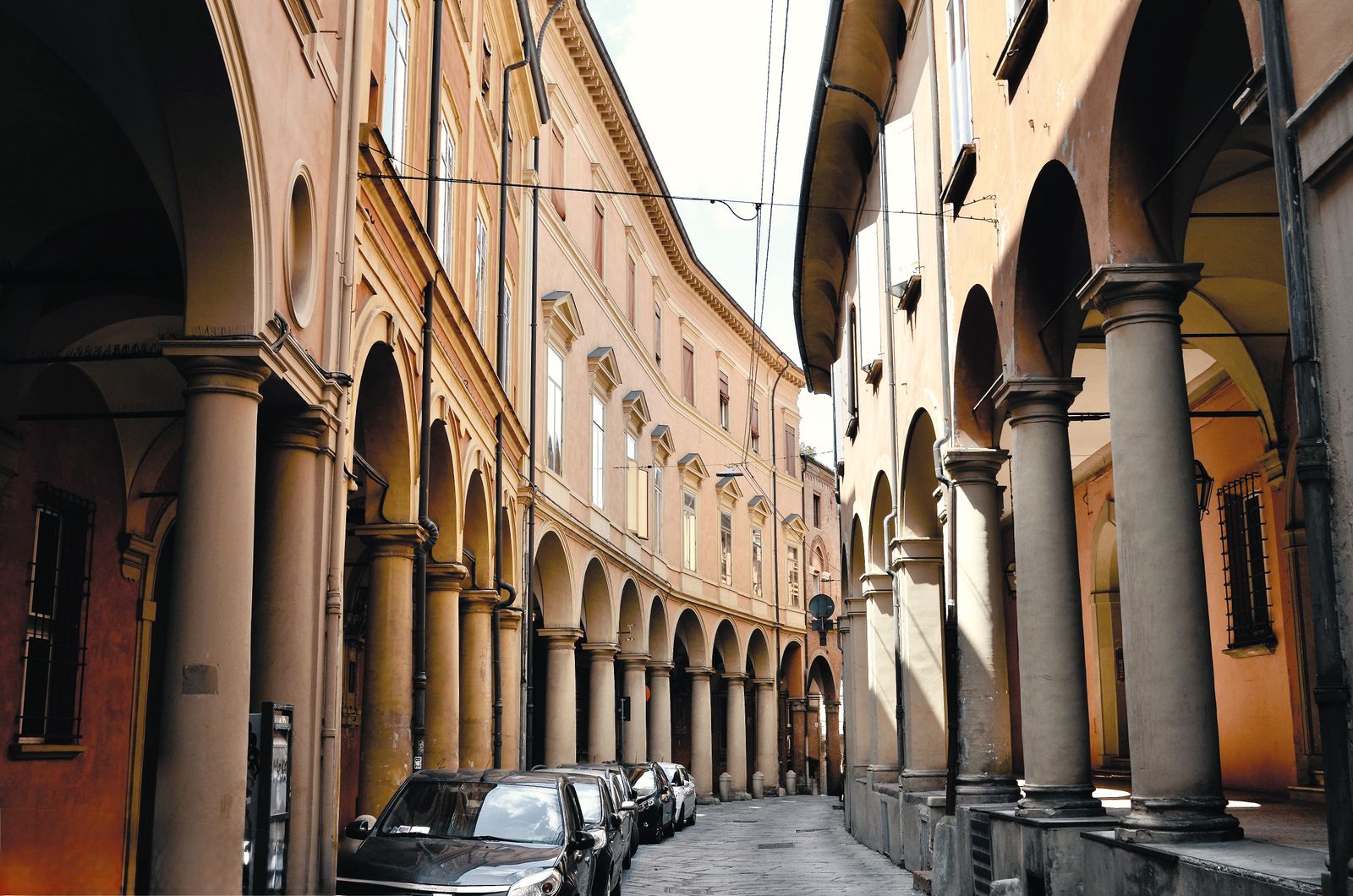
Along the way, look up. The upper floors of the Quadrilatero still have the shape of medieval houses, and the porticoes on the streets around it, part of the UNESCO-listed porticoes of Bologna, kept shoppers dry long before anyone thought of a covered market.

What to Look For at the Counters
The pleasure of a food walk in the Quadrilatero is not one big meal. It is a series of small things, eaten standing up. These are the ones we would look for.
- Mortadella, cut to order. Bologna’s great cured meat is sliced thin at the counter, and it tastes completely different from anything pre-packed. Ask for a few slices to eat on the spot.
- Parmigiano Reggiano by age. Most cheese shops label their wedges by months of ageing, commonly 24 and 36 months or more. Try two side by side: the younger one is milky and soft, the older one drier, sharper and full of tiny crystals.
- Fresh pasta in the windows. Trays of tortellini, tortelloni and tagliatelle are made fresh and sold by weight. Even if you are not cooking, it is worth watching how small the tortellini are. That is the standard in Bologna.
- Prosciutto, culatello and salame hanging above the counters in the salumerie, and crescentine, the soft fried bread eaten here with cured meats.
- Seasonal produce. In autumn, look for porcini, chestnuts and persimmons; in spring, asparagus and the first cherries from the hills near Vignola.
- A glass of the local wine. Pignoletto, the white from the hills around Bologna, or a dry Lambrusco from nearby Modena, both of which work well with salty, fatty food.
A simple rule: buy small amounts, and buy them where you see people from Bologna queueing. If you would like to know more about what you are eating, our guide to food experiences in Bologna covers the markets, pasta classes and dairies beyond the Quadrilatero.
When to Go, and How to Behave
Timing matters more than the route. The Quadrilatero is at its best on weekday and Saturday mornings, roughly from opening until lunchtime, when the stalls are full and locals are shopping for the day. Late morning gets busy with visitors. Many food shops close for a few hours in the afternoon and reopen later. Sunday is quiet, with many stalls and shops closed. In the early evening the mood changes, as the counters wind down and the wine bars and small eating places in the side lanes fill up for aperitivo.
A few habits that help:
- Don’t touch the produce. At most fruit and vegetable stalls you point and the seller picks for you.
- Say good morning. A buongiorno when you walk into a small shop makes a difference.
- Ask before you photograph the inside of a shop or the person behind the counter.
- Keep to one side. The lanes are narrow and they are working streets, with deliveries and locals on bicycles.
- Carry a little cash for small purchases, although cards are widely accepted.
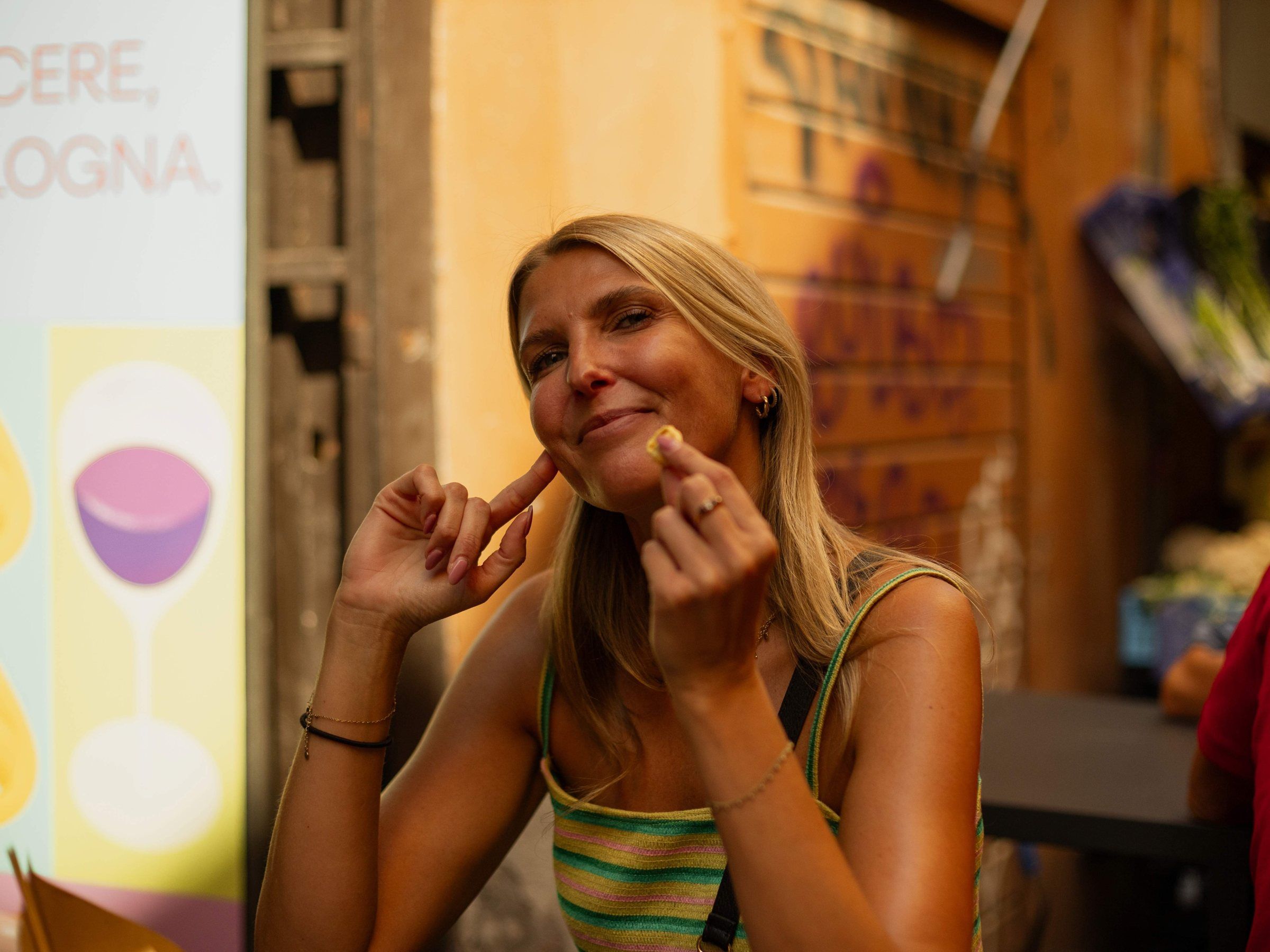
Doing It on Your Own or With a Guide
Walking the Quadrilatero on your own is easy, and with this route and a good appetite you will eat well. What you miss, inevitably, is the story behind each counter: why a shop has looked the same for a century, what makes one mortadella better than another, which family has run which stall. Many of the oldest shops in the area are in our guide to historical restaurants in Bologna, if you want to add a few to your walk.
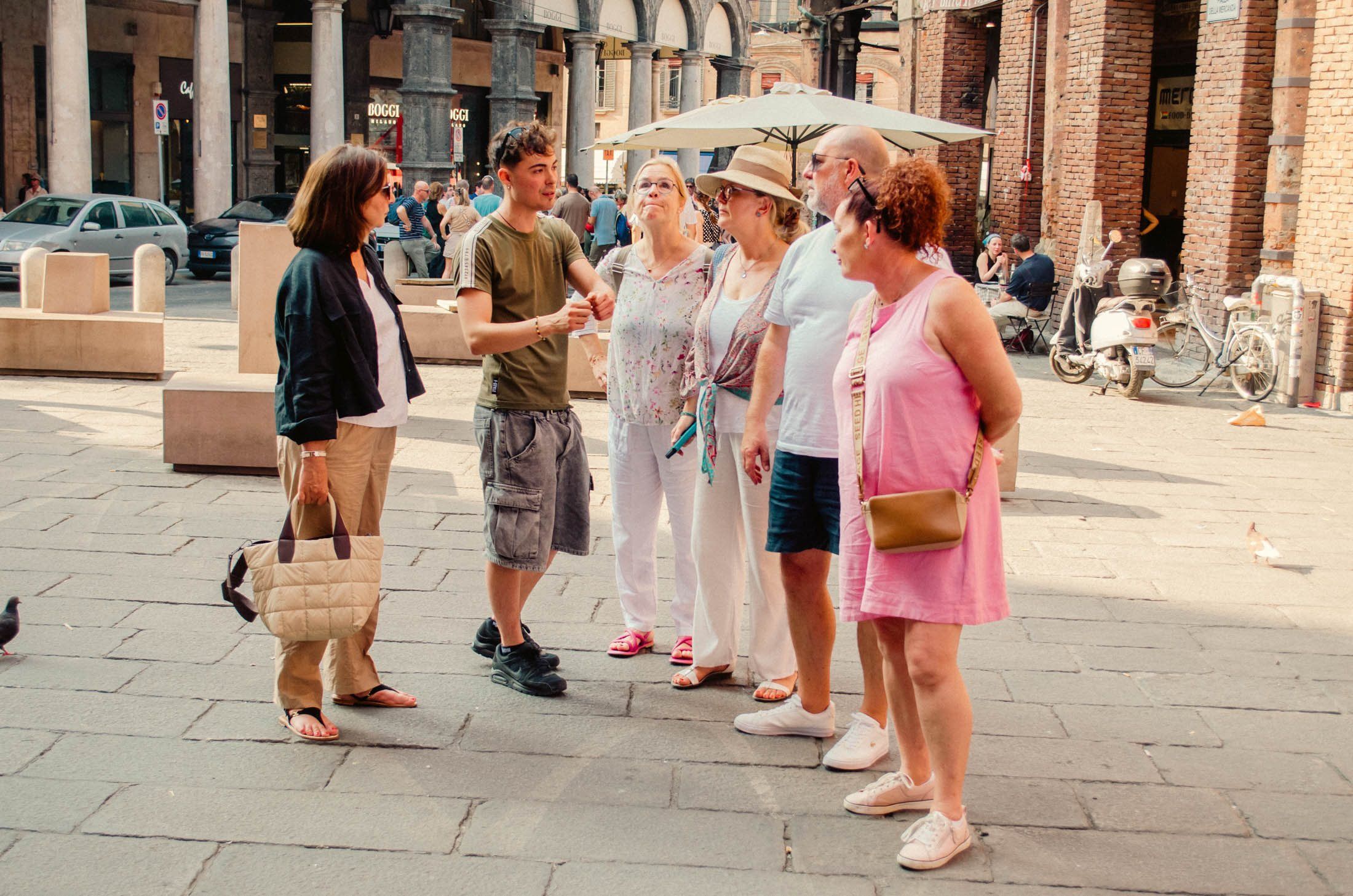
If you would rather have someone to walk it with, our Street Food Tour (€65, two hours, starting at 11:30 or 18:00) is a small-group walk through the medieval alleys and market streets from Piazza della Mercanzia, tasting what Bologna eats between meals, with local wine along the way. It is one way to do it, and if you are comparing companies, our guide to choosing a Bologna food tour covers what to look for. The other way is a morning, comfortable shoes and no particular plan.
A Few Questions We Get Asked
How long does a food walk in the Quadrilatero take? An hour to see it, two to three if you are eating as you go. The area is small, so time is spent at the counters rather than walking.
Is it worth going if I am not buying anything? Yes. It is free to walk, the shop windows are half the pleasure, and Santa Maria della Vita alone is worth the detour.
Can I eat a full meal there? You can, at the osterie and small restaurants in the side lanes, but the Quadrilatero is at its best as a place to graze: a few slices here, a piece of cheese there, a glass of Pignoletto to finish.