Blog19 November 2026
Truffle Season in Tuscany: When to Go Truffle Hunting
Truffle hunting in Tuscany explained: white and black truffle seasons, what a hunt with a truffle hunter and dog is really like, and what to eat afterwards.
Truffle hunting in Tuscany is quieter and muddier than most people imagine, and far more interesting: an early start, a hunter who knows every tree on the hillside, and a dog working the ground with its nose down and its tail going. When the dog stops and starts to scratch, everyone holds their breath. Sometimes there is a truffle. Sometimes there is not, and that is part of it.
We plan truffle mornings in Tuscany as part of our private journeys, and these are the things we tell people before they go: which truffle is in season when, where in Tuscany they grow, what actually happens on a hunt, the rules the hunters follow, and what to eat once you are out of the woods. The seasons below are set by regional law and can be adjusted, so always check the dates for your trip.
Truffle Season in Tuscany: White, Black and the Ones in Between
The first thing to know is that “truffle season” is not one season. Tuscany has several kinds of edible truffle, and each has its own dates in the regional calendar, set by the Tuscan truffle law of 2023. Many websites still quote older dates, so here is the current calendar as published by the Associazione Tartufai Senesi, the Siena truffle hunters’ association.
- White truffle (Tuber magnatum, the tartufo bianco pregiato): 1 October to 15 January. This is the famous one, pale and knobbly, with a scent that fills a room. It cannot be farmed, which is why it is so prized.
- Black truffle (Tuber melanosporum, the tartufo nero pregiato): 15 November to 15 March. Dark, with a warty skin and a deep, earthy flavour. It is less common in Tuscany than in some other regions.
- Summer truffle (Tuber aestivum, the scorzone): 1 June to 31 August, and again from 1 October to 30 November. Milder and much more affordable, and the truffle most summer visitors will see.
- Autumn black truffle (Tuber uncinatum): 1 October to 15 January.
- Bianchetto or marzuolo (Tuber borchii): 15 January to 15 April. A small spring white truffle with a sharper, garlicky scent.
There is one detail that catches people out. In Tuscany, searching for truffles of any kind is not allowed in May or in September, a rest period for the woods. So a truffle hunt is possible for most of the year, but not every month, and the truffle you find depends entirely on when you go.
If the white truffle is the point of your trip, aim for October to December. If you are travelling in summer, a hunt for the scorzone is still a lovely morning, and the dog does not care which truffle it is looking for.

Where the Truffles Are
Truffles grow underground, in partnership with the roots of particular trees, so you find them where the soil, the trees and the moisture are right. In Tuscany that means a few well-known areas.
The best known for white truffles are the hills around San Miniato, a hill town between Florence and Pisa, where the truffle grows among poplars, willows, oaks and lindens. Further south, the Crete Senesi, the bare clay hills south-east of Siena, have their own white truffle tradition centred on the village of San Giovanni d’Asso. The Mugello, north of Florence, the Casentino and the Val Tiberina in the province of Arezzo are also good white truffle country. The spring marzuolo likes the sandy soils of the Maremma coast.
You will not usually be told exactly where a hunt takes place, and you should not ask. Truffle grounds are a family secret, passed down and guarded closely. Part of what you are paying for is the privilege of being taken along.

What a Truffle Hunt Is Really Like
A good hunt is a walk in the woods with a purpose. Most start in the morning, meeting the hunter, or tartufaio, and their dog at the edge of the trees. In Italy, truffle hunting is done with dogs. Lagotto Romagnolo dogs, a curly-coated Italian breed, are a popular choice, but plenty of hunters work with mixed breeds they have trained themselves.
Then you walk. The hunter reads the ground, steering the dog towards the trees where truffles have been found before, and talking about the soil, the weather and the season as you go. The dog ranges ahead, nose down. When it picks up a scent it starts to dig, and the hunter moves in quickly, calls the dog off with a treat, and finishes the job by hand with a small narrow spade called a vanghetto. A ripe truffle can be a few centimetres under the surface or deeper. Then the hole is filled in again, and the walk carries on.
A few things are worth knowing in advance:
- Nothing is guaranteed. Truffles are wild. A good hunter will usually find something in season, but it might be a single small truffle, and in a dry spell it might be nothing at all.
- It is outdoors and often muddy. Wear boots or sturdy shoes you don’t mind getting dirty, and dress for the weather. Autumn mornings in the hills can be damp and cold.
- It is gentle walking, not a hike. You will be on uneven woodland paths for an hour or two, sometimes on slopes, but you are going at the dog’s pace.
- The hunter is the heart of it. The best mornings are the ones where you have time to ask questions.
In 2021, UNESCO added truffle hunting and extraction in Italy to its list of the Intangible Cultural Heritage of Humanity, recognising exactly this: the knowledge hunters pass down about the land, the plants and the dogs.
The Rules Every Truffle Hunter Follows
Truffle hunting in Italy is regulated, and the rules are part of what makes it sustainable. Under the national truffle law, every hunter must pass an exam to receive a licence, the tesserino. The search must be done with a trained dog, and digging must use the proper tool and be limited to the spot where the dog started. Holes must be filled in afterwards with the soil that came out of them, so the ground and the roots can recover.
Tuscany adds its own rules on top: the calendar above, the closed months, and set hours for hunting, which run from early morning until dusk and change with the month. Regional authorities can also close specific areas or periods when needed.
For a visitor, this means two things. First, you need a licensed hunter; it is not something to try on your own in the woods. Second, any truffles found belong to the hunter. On a well-arranged hunt they are usually cooked for you, or added to your lunch, but it is worth asking how it works when you book.

What to Eat After the Hunt
The best part of a truffle morning is often the meal that follows, because truffles are simple food at heart. The key difference is between white and black.
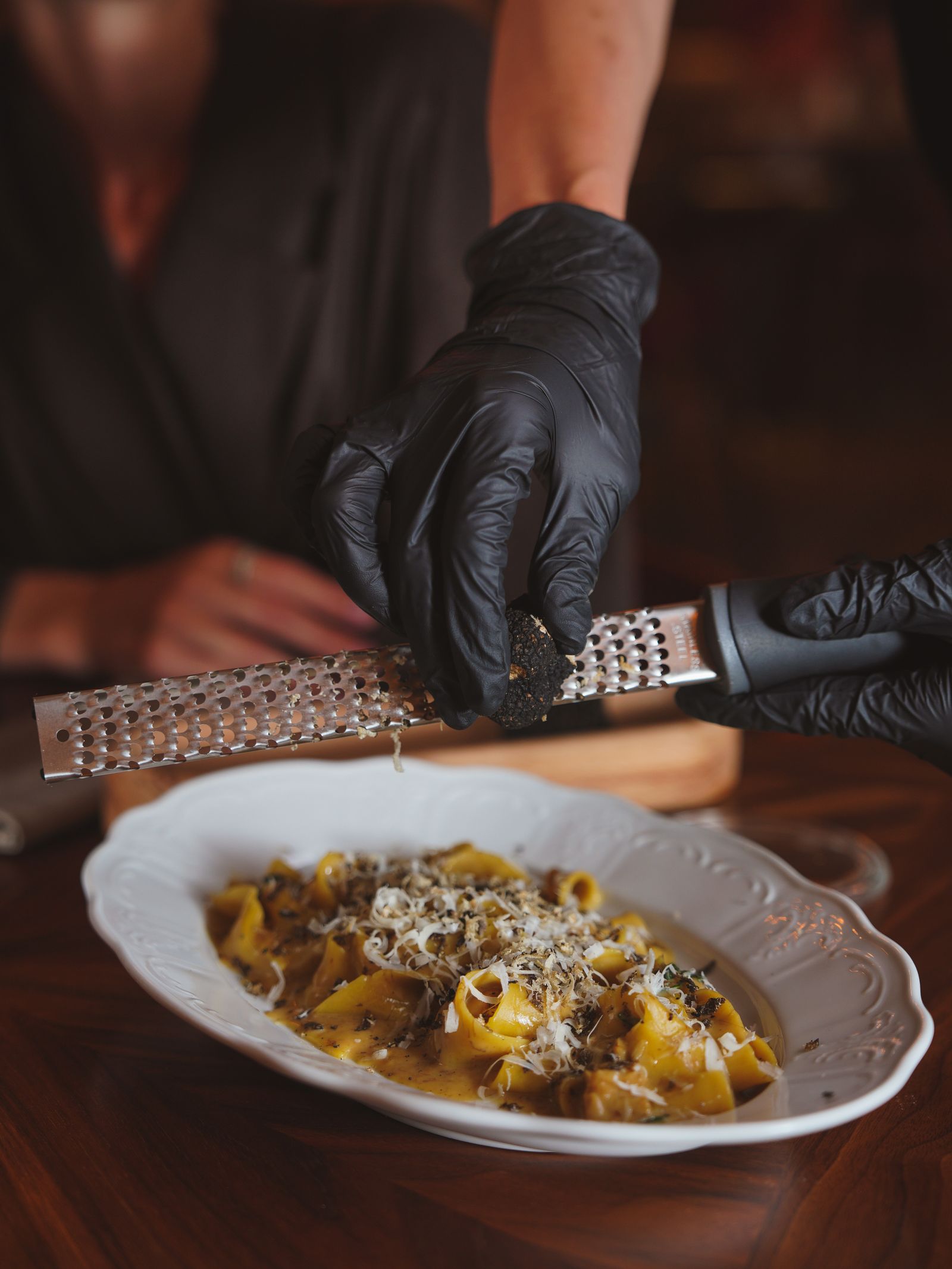
White truffle is never cooked. It is shaved raw, at the table, over something hot and plain that lets the scent come through: fresh egg pasta such as tagliolini or tagliatelle with butter, a fried egg, a risotto, or a few crostini. Heat would destroy the aroma, so the shaving happens at the very last moment.
Black truffles can take a little heat. They are grated or sliced into sauces, folded into eggs, or warmed gently with butter or oil. The summer scorzone, milder than the winter black, is lovely sliced thinly over pasta or on bread with good Tuscan olive oil.
A glass of local red sits naturally alongside: a Chianti Classico, or a Sangiovese from the hills where you have been walking. If the hunt is followed by a cooking lesson, you will usually make the pasta yourself, which is the best way to understand how little a truffle needs.
Truffle Hunting in Tuscany: Planning Your Morning
A few practical points make the difference between a good morning and a disappointing one.
Choose your season first. Decide whether you want the white truffle, which means October to December, or are happy with whatever is in season. Avoid May and September, when hunting is closed.
Book ahead, especially in autumn. White truffle season is busy, and good hunters are booked well in advance. A private hunt, just your group with the hunter and the dog, is far more rewarding than a large group trailing through the trees.
Allow for travel. Truffle grounds are in the countryside, often some way from the nearest town, so you will need a car or a driver. Combine the hunt with lunch and a slow afternoon, rather than squeezing it between two cities.
Think about the fairs. In November, the truffle towns hold markets where you can see, smell and buy white truffles. San Miniato’s Mostra Mercato Nazionale del Tartufo Bianco reached its 55th edition in 2026, running over three weekends from 14 to 29 November. San Giovanni d’Asso’s white truffle fair, in the Crete Senesi, held its 40th edition over two weekends earlier in November. Dates change each year, so check before planning around them.
Our truffle hunting experience is a private morning in the Tuscan hills: you follow a hunter and their dog through the woods, then cook a simple Tuscan meal with what you found. It is also part of our Italy Through Food & Wine journey, which begins with producers in Bologna and Emilia-Romagna, continues into Tuscany and finishes in Rome, and of our Tuscany & the Amalfi Coast journey. Either is one way to do it, and we shape each one around your dates and interests.
A Few Common Questions
When is the best time for truffle hunting in Tuscany? For white truffles, October to December. For a hunt in general, any month except May and September, when searching is closed.
Do they still use pigs? No. Italian law requires truffle hunting to be done with a trained dog.
Is truffle hunting suitable for children? Usually yes, as long as they can manage an hour or two of walking in the woods. Most children love watching the dog work.
Can I take the truffles home? Truffles found on a hunt belong to the hunter. If you want to buy some, ask when you book, or visit one of the November fairs.